
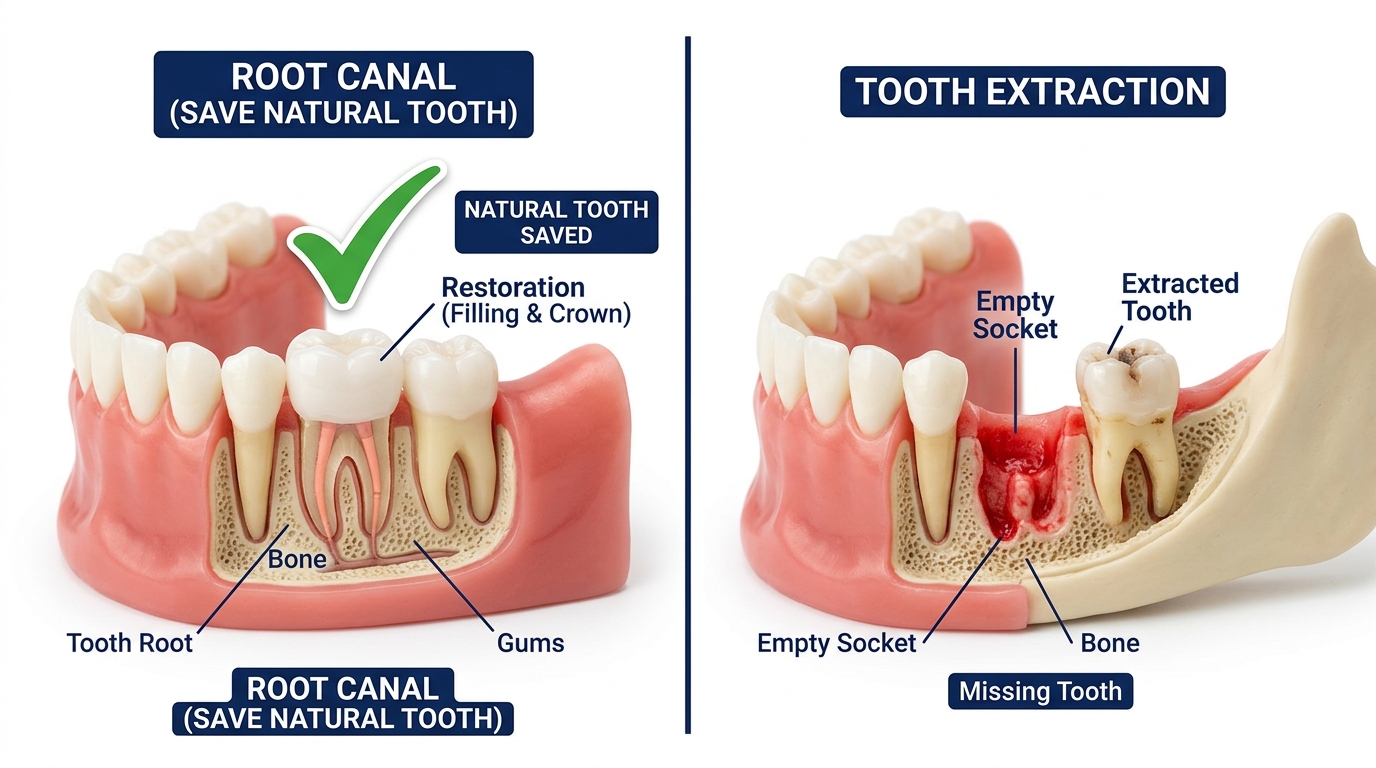
Root canal treatment vs tooth extraction, which is better? To answer that, we first have to understand when these two treatments are required.
A damaged or infected tooth does not always need to be removed. In many cases, a dentist can treat the infection and preserve the natural tooth with a root canal. However, if the tooth has suffered severe damage and cannot be restored, extraction may be the safer and more practical option.
The right treatment depends on how much of the tooth remains healthy, the extent of the infection or damage, and whether the tooth can be restored successfully. Your dentist may also consider the condition of the surrounding gums and bone before recommending a treatment.
This guide explains the differences between the two procedures, their benefits and risks, recovery time, and cost. It also explains when a dentist may recommend saving a tooth with a root canal and when extraction may be necessary.
Root Canal Treatment vs Tooth Extraction: What Do They Involve?
The two procedures solve different problems. Root canal treatment repairs the inside of a tooth, while extraction removes a tooth that cannot be saved.
What Is Root Canal Treatment?
Root canal treatment is used when the soft tissue inside a tooth, called the pulp, becomes infected or damaged. This can happen because of deep decay, a crack or fracture, or an injury to the tooth.
During the procedure, the dentist removes the infected or damaged pulp, cleans and disinfects the root canals, and then fills and seals them.
The main aim of root canal treatment for a damaged tooth is to remove the infection while keeping the natural tooth in place. After treatment, the tooth usually needs a filling or crown to restore its strength and protect it from further damage.
What Is Tooth Extraction?
Tooth extraction involves removing a tooth from its socket. It may be recommended when a tooth is too damaged, decayed, or structurally weak to be restored.
For example, a tooth extraction for a severely damaged tooth may be necessary when there is not enough healthy tooth structure left to support a restoration. Extraction can also be considered when a tooth has a severe fracture or when other treatment options are unlikely to provide a predictable result.
Unlike root canal treatment, extraction does not preserve the natural tooth. Depending on the location of the missing tooth and your oral health, your dentist may later recommend replacing it with an implant, bridge, or another type of dental restoration.
Which Is Better: Root Canal or Tooth Extraction?
When deciding which is better root canal or tooth extraction, the condition of the tooth is the most important factor. If enough healthy tooth structure remains and the tooth can be restored, root canal treatment is generally preferred because it allows you to keep your natural tooth. If the damage is too severe, extraction may be the better option.
- Amount of healthy tooth structure: A tooth needs enough healthy structure to support a filling, crown, or other restoration. If too little remains, saving it may not be possible.
- Extent of infection: A root canal can treat an infection that has reached the pulp. However, the dentist needs to assess whether the infection can be treated successfully.
- Cracks or fractures: A minor crack may not prevent treatment, but a tooth that is split or severely fractured may not be restorable.
- Condition of the surrounding tissues: The gums and bone supporting the tooth also affect its long-term outlook.
- Long-term prognosis: The goal is not just to treat the immediate problem. The dentist needs to consider whether the tooth is likely to remain functional after treatment.
Root Canal vs Extraction: Pros and Cons
Both treatments address serious dental problems, but they have distinct benefits and long-term considerations:
Root Canal Treatment: Benefits
One of the main root canal treatment benefits is that it preserves your natural tooth. Keeping the tooth helps maintain normal biting force, efficient chewing, and avoids leaving a gap in your smile.
Root canal treatment eliminates infection inside the tooth without removing the root foundation. Once properly restored with a crown, it functions like a natural tooth for years to come.
Tooth Extraction: Benefits and Risks
Tooth extraction is the appropriate choice when a tooth is unsavable due to advanced decay or structural failure. Removing the tooth eliminates acute pain and stops infection from spreading.
However, extraction leaves a gap that can cause adjacent teeth to shift, alter your bite, and cause bone loss. Replacing the extracted tooth with an implant or bridge adds subsequent treatment steps and long-term cost.
Root Canal vs Extraction: Cost and Recovery Time
Cost and recovery time differ significantly when considering the total treatment pathway:
- Initial vs Total Cost: Extraction may cost less initially, but adding an implant or bridge later usually makes total tooth replacement more expensive than saving the tooth with a root canal.
- Recovery Process: Root canal recovery involves mild sensitivity for a few days before immediate function is restored. Extraction recovery requires gum and socket healing, followed by additional healing phases if an implant is placed.
How Does a Dentist Decide Between Root Canal and Extraction?
During a comprehensive examination with X-rays, your dentist evaluates remaining natural tooth structure, root canal anatomy, bone density, gum support, and long-term stability before recommending treatment.
Root Canal Treatment in Bilekahalli: Why Choose DentaCare?
If you are seeking Root Canal Treatment or Dental Extraction in Bilekahalli, Bengaluru, Dentacare prioritizes tooth preservation whenever clinically predictable, providing expert endodontic care and gentle surgical extractions tailored to your long-term oral health.
Frequently Asked Questions
Is a root canal better than a tooth extraction?
If the tooth can be restored successfully, a root canal is generally preferred because it preserves your natural tooth. Extraction is recommended when structural damage is too severe to save the tooth.
Can a damaged tooth be saved with root canal?
Yes, provided enough healthy tooth structure remains and the root infection can be completely cleaned and disinfected.
When is tooth extraction necessary?
Extraction is necessary when a tooth has vertical root fractures, deep decay below the gumline, severe bone loss, or extensive destruction that cannot support a crown.
Is a root canal more painful than a tooth extraction?
Both procedures are performed comfortably under local anesthesia. Modern root canal treatment feels similar to getting a standard filling.
What happens if I delay treatment for a damaged or infected tooth?
Delaying treatment allows bacteria to spread deeper into the jawbone, resulting in severe pain, abscess formation, and turning a tooth that could have been saved with a root canal into one requiring extraction.